
English| EUR
Suggested for you
More currencies
Choose a language
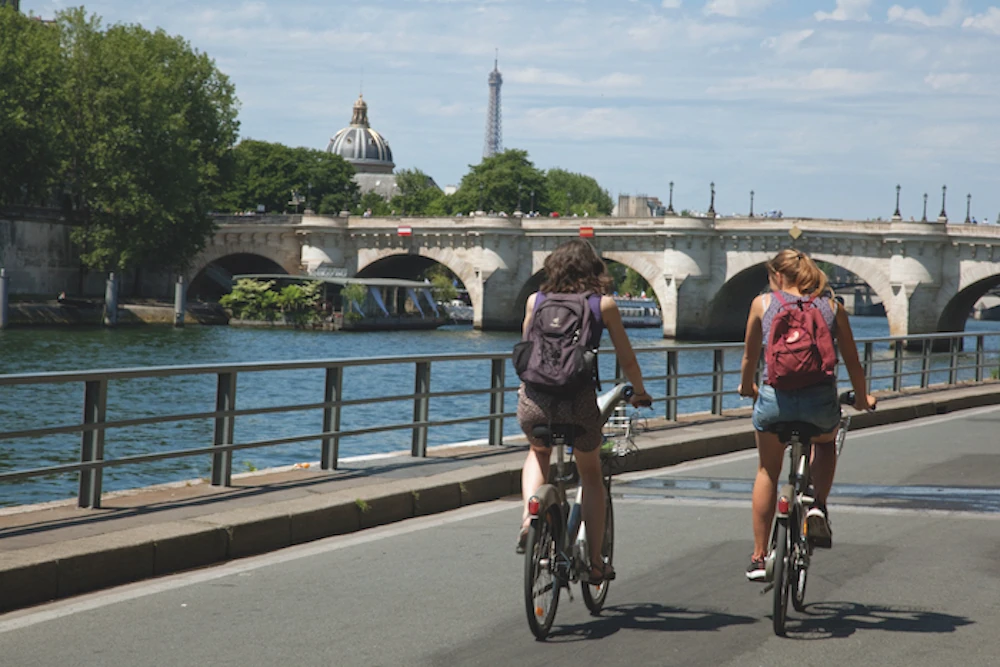
Paris has transformed its streets over the past decade into one of Europe's most ambitious cycling experiments. More than 1,000 kilometers of dedicated cycle lanes now cross the city, supported by Europe's largest bike-share system and a municipal government committed to reducing car traffic. The question for visitors and new residents is no longer whether Paris welcomes cyclists, but how to navigate its evolving infrastructure confidently.
Quick answer
Paris is increasingly bike friendly, with over 1,000 kilometers of cycle lanes covering the city and more than 1,400 Vélib' bike-share stations operating around the clock. Protected lanes now run along the Seine, Rue de Rivoli, and Boulevard de Sébastopol, while 30 km/h speed limits apply across most residential streets. Morning hours between 7:00 and 10:00 offer the smoothest conditions before traffic builds.
Paris added 180 kilometers of temporary cycle lanes during the pandemic and made most of them permanent, a decision that reshaped how the city moves. The network now includes wide protected lanes separated from car traffic by concrete barriers, painted advisory lanes on quieter streets, and shared bus-bike corridors that give cyclists priority over private vehicles. Rue de Rivoli, once one of the most congested car routes through the historic center, became a cyclist-only thoroughfare in 2020 and now carries more than 15,000 bike trips per day. The infrastructure is uneven. The Right Bank, particularly the 1st through 11th arrondissements, offers the densest network of protected lanes, while parts of the Left Bank and outer arrondissements still rely on painted markings that drivers frequently ignore. Cyclists heading east-west along the Seine benefit from continuous protected paths on both banks, but north-south routes often require navigating mixed traffic or switching between disconnected segments. The city's cycling map, available at paris.fr, shows which routes are fully protected and which require confidence in traffic. Vélib' Métropole operates 20,000 mechanical and electric bikes across Paris and surrounding communes, with docking stations spaced every 300 meters in dense neighborhoods. The system runs continuously, including overnight when cycling conditions are calmest. Electric Vélib' bikes handle the city's hills and longer distances without the effort required by mechanical models, though they cost slightly more per minute and run out faster during weekday commutes. The service integrates with Navigo transit cards and accepts international credit cards at any station kiosk. Parisian drivers are adapting to the new lane network, but the adjustment is incomplete. Delivery vehicles park in cycle lanes, taxis merge without checking mirrors, and tourists step off curbs without looking. Cyclists here ride assertively but not aggressively, claiming their lane space while staying alert to doors opening, pedestrians crossing, and motorbikes weaving through traffic. The city is more forgiving than it was five years ago, but it still rewards riders who know how to hold a line and signal clearly. The question of whether Paris welcomes cyclists depends less on infrastructure alone than on timing and route selection. Early mornings before 10:00 and late evenings after 20:00 see lighter traffic and cooler temperatures, particularly in summer. Weekends bring leisure cyclists to the Seine banks and Canal Saint-Martin, where car access is restricted and the pace is relaxed. Avoid cycling during weekday rush hours on unprotected routes, and plan trips using the city's official cycle map rather than generic navigation apps that still route cyclists onto hostile roads.
“Rue de Rivoli, once one of the most congested car routes through the historic center, became a cyclist-only thoroughfare in 2020 and now carries more than 15,000 bike trips per day.”
Access to public cycling infrastructure in Paris is provided at no cost. Using the city's streets and designated cycle paths requires no admission fee.
Verdict: Cyclists pay 0 EUR to access the city's infrastructure, with costs only applying to independent equipment rental or guided services.
To experience Paris at its most accessible, the best arrival window is 07:00–10:00. Cycling during these hours allows you to navigate the city when traffic is lighter and temperatures remain cooler.
—
Morning rides provide the quietest routes through the city center. This window helps avoid the intensity of the daily rush.
Variable; check forecast
Traffic increases as business activity peaks. Plan your route to utilize dedicated cycle paths during this time.
Variable; check forecast
Leisure cyclists and pedestrians fill major arteries. Proceed with extra caution in tourist-heavy zones.
Verdict: The optimal period for a smooth ride is Tuesday to Thursday between 07:00–10:00.
Paris features an expanding network of cycle infrastructure under the Plan Vélo, making it increasingly accessible for cyclists. The Hôtel de Ville, located at 75004 Paris, France, sits at the heart of this network and is well-connected by primary cycle paths.
Line 1 or 11 to Hôtel de Ville station
Follow marked cycle paths toward 75004 Paris
Drop-off near Rue de Rivoli
The best arrival window is 07:00–10:00 to experience light traffic and cooler temperatures before the daily rush. Cycling to the city center is free, as there is 0 EUR entrance fee for cyclists to public streets and cycle paths.
Navigating Paris by bike requires understanding local infrastructure and specific riding customs to move efficiently alongside urban traffic.
Look for physically separated cycle tracks denoted by curbs or bollards, which provide a dedicated space away from motor vehicles. These lanes are often marked with specific bicycle icons painted on the pavement.
Parisian one-way streets frequently allow two-way bicycle traffic, indicated by signs reading 'Sauf Vélo'. Always check for these signs before deciding to detour around a block.
French cyclists rely on clear hand signals to communicate turns and stops to drivers and other riders. Extend your arm fully to the side before changing lanes to ensure visibility.
Bicycle-specific traffic signals, often smaller than standard lights, govern movement at many intersections. Stop at all red lights unless a specific sign permits cyclists to turn right or proceed straight despite the signal.
Position yourself in the 'sas vélo'—the designated area between the stop line and the crosswalk—while waiting at red lights. This places you in front of motor vehicles, making you more visible when the light changes to green.
Cyclists new to Paris often misjudge the city's infrastructure and traffic patterns, leading to frustration or unsafe situations. Recognizing these pitfalls helps you navigate confidently.
Assuming all major streets have bike lanes
Paris bike infrastructure is concentrated in certain districts. Check route maps before departure—many historic corridors lack dedicated lanes and require sharing space with cars in narrow passages.
Ignoring one-way street rules in older districts
One-way restrictions apply to cyclists in areas like Le Marais and the Latin Quarter. Riding against traffic flow, even on quiet streets, risks collisions and fines—always follow directional signage.
Underestimating rush-hour traffic density
Morning and evening peaks (08:00–09:30, 17:30–19:30) bring heavy vehicle volume on arterial routes. Plan rides outside these windows or choose Seine-side paths where separated infrastructure reduces conflicts.
Overlooking cobblestone routes in tourist zones
Cobbled streets near Notre-Dame and Montmartre create handling challenges and increase puncture risk. Use wider tires (28mm minimum) and reduce speed on uneven surfaces to maintain control.
Relying solely on Vélib' stations in outer arrondissements
Vélib' density drops significantly beyond the périphérique and in residential 19th–20th arrondissements. Confirm station locations along your entire route or consider a personal rental for trips beyond central Paris.
Everything you need to know about is paris bike friendly
Paris has significantly expanded its cycling infrastructure, making it increasingly accessible for casual riders to explore the capital. Many districts now feature dedicated lanes, confirming that it is paris bike friendly for those looking to traverse the city at their own pace.
Public streets and cycle paths are accessible at an entry fee of 0 EUR. This ensures that the primary infrastructure remains open to everyone who is paris bike friendly in their transport choices.
The best arrival window for cycling is 07:00–10:00, which offers light traffic and cooler temperatures before the daily rush begins. Planning your ride during these early hours allows for a more relaxed experience across the city's thoroughfares.
Yes, local guides offer various excursions that help you discover Paris landmarks while learning the local rules of the road. These curated experiences are a great way to see if paris bike friendly routes meet your expectations for a guided outing.
While the city continues to improve, parents should prioritize routes on designated paths and park areas to ensure safety. Many visitors find that paris bike friendly initiatives have made it easier to manage family outings, provided you stick to protected lanes.
A common error is failing to signal intentions to other road users or ignoring the local right-of-way rules. Always stay aware of your surroundings, especially near major intersections or where bike lanes merge with vehicular traffic.